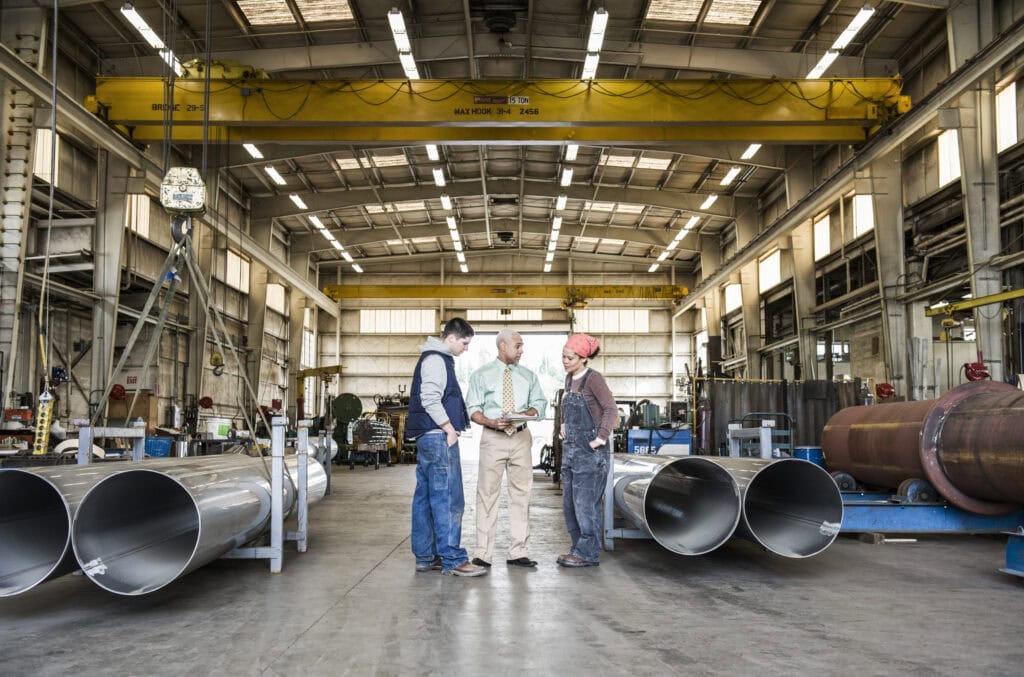
You know metal fabrication plays a central role in modern manufacturing, but the moment you start looking into it, it can feel like a maze. Welding methods, ASME codes, material choices, and forming capabilities all matter, and one wrong decision can result in costly delays, compliance issues, or equipment that doesn’t perform as intended.
We created this guide for plant managers, engineers, and operations teams who need clear, practical information about industrial metal fabrication. No fluff. No oversimplification. Just real-world insights based on decades of experience in the field.
Here’s what you’ll find inside:
- A deep dive into core fabrication processes (welding, cutting, rolling, forming, and machining) and how each impacts the performance and longevity of your equipment.
- Applications across various industries, such as chemical processing, food production, water treatment, and energy
- Illustrate how fabrication standards vary depending on the type of material your plant handles.
- Material selection: which metals handle heat, corrosion, or food safety best (and where cutting corners ends up costing far more).
- Industry standards & certifications you can’t skip, such as ASME, code stamps, safety & inspection rules, and what they mean in practical terms for manufacturing and maintenance.
- Tips from the field: how Schmidt sees projects go smoothly, where things often go sideways, and what you can do to avoid the most common pitfalls before they become full‐blown crises.
Table of Contents
- What is Metal Fabrication?
- The Metal Fabrication Process
- Material Selection in Industrial Metal Fabrication
- Industry Applications of Metal Fabrication
- Industry Standards and Certifications
- How to Choose the Right Metal Fabricator
- Why Experience Matters: The Schmidt Advantage
What is Metal Fabrication?
First things first. What is metal fabrication, and why is it needed?
Metal fabrication is the process of transforming raw metal into the tanks, vessels, piping, and structural components that enable industrial production. It’s where design meets metallurgy.
From the outside, a tank is a simple cylinder. But inside? It’s a carefully engineered system of heavy-gauge steels, weld procedures qualified to ASME code, and precision machining designed for leak-free performance under pressure. Nothing about industrial equipment is “standard”; each component is custom-fabricated to match exact specifications.
Without metal fabrication, power plants wouldn’t run, refineries couldn’t process hydrocarbons, and sanitation-critical industries like food production would come to a standstill. Every weld, rolled plate, and precisely machined surface plays a role in keeping materials contained, products safe, and facilities efficient.
That’s why fabrication matters because the difference between flawless performance and costly downtime is decided long before the tank leaves the shop.
Schmidt Industrial Services has been providing these services since 1948, including cutting, forming, welding, coating, and validation of metal components for industries where failure isn’t an option. Our work exists behind the scenes, but it enables everything in front of them to run smoothly.
Where does fabrication make the biggest difference to ROI?
If you’re asking where fabrication most impacts ROI, it’s upfront in choosing the right alloy, welding process, and inspections. Those choices extend service life and prevent unplanned outages.
Who should own fabrication decisions: engineering, maintenance, or procurement?
When it comes to ownership, the best results happen when engineering, maintenance, and procurement share responsibility. Specifications, field realities, and vendor risk all need a seat at the table.
The Metal Fabrication Process
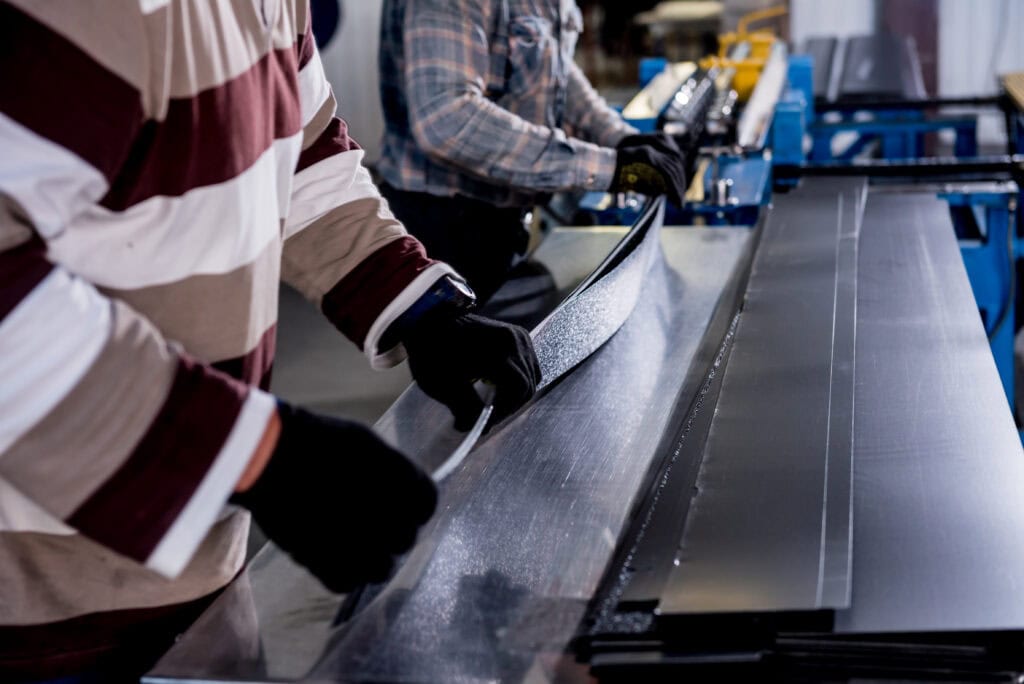
Every great piece of industrial equipment starts as a flat plate, a raw billet, or a sheet metal blank. Through a series of carefully controlled forming, cutting, and welding processes, it becomes something precise, durable, and ready for service.
Here’s how it all comes together…
Rolling and Forming
The roll forming process is the foundation of large-scale fabrication. A roll forming line gradually bends flat low-carbon steel plates, stainless steel, or nickel alloys into the desired shape, including cylindrical pressure vessels, storage tanks, and custom pipes.
Roll forming is where physics meets precision. Each plate must be heated, aligned, and guided through the rollers to achieve exact curvature without stress fractures or weak points. In many cases, the process is combined with welding and heat treatment to stabilize the metal’s grain structure and prevent warping.
At Schmidt, our fabrication facility can handle plates up to 12 feet in diameter and weighing up to 31,000 pounds, forming everything from simple sheet metal cylinders to thick, structural steel components used in power generation or refinery environments.
Cutting and Preparation
Before forming or welding, each plate must be accurately cut to size. For example, we have CNC-controlled cutting systems that are capable of handling both thick and thin sections. Depending on the project’s material and tolerance requirements, fabricators may use plasma, oxy-fuel, or mechanical shearing to achieve a clean edge and uniform fit-up.
The goal? No gaps, no distortion, and minimal rework. Every cut surface affects weld quality, so proper edge prep is part of Schmidt’s built-in QA process.
Welding
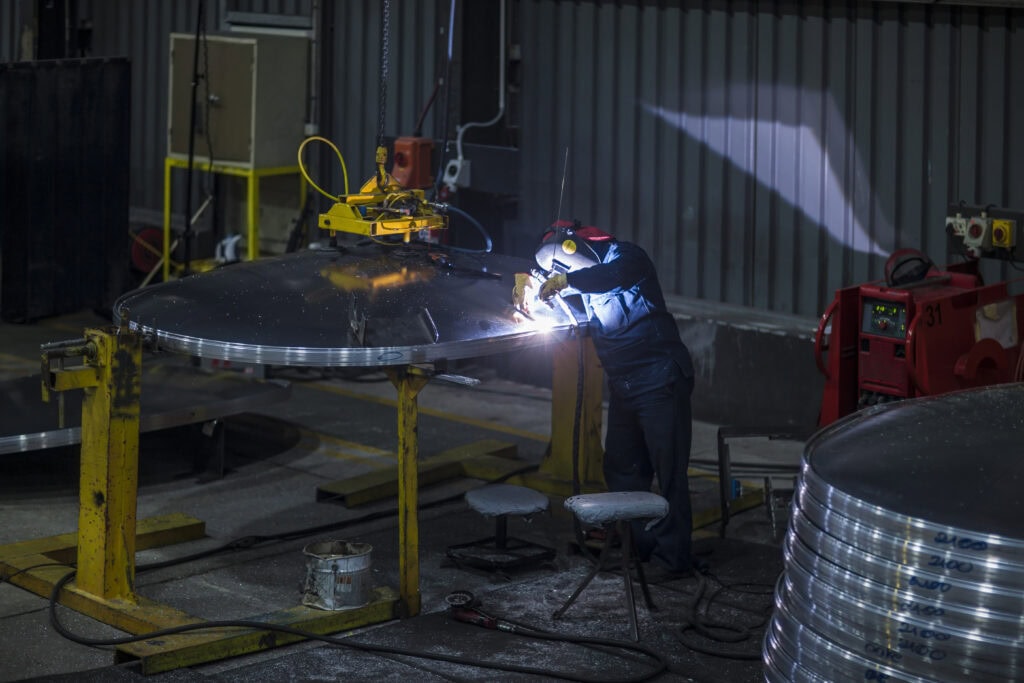
This is where fabrication becomes both art and science. Multiple welding processes are used depending on the metal, application, and service environment. Let’s break down the most common types and how they work.
Gas Tungsten Arc Welding (GTAW / TIG Welding)
TIG welding delivers high precision and clean results, particularly with stainless steels, aluminum, and non-ferrous metals like copper. It uses a tungsten electrode and shielding gas (typically argon) to create a stable welding pool of molten metal.
- Produces high-quality welds with excellent surface finish.
- Ideal for thin metal plates and sanitary or food-grade applications.
- Commonly used in confectionery, pharmaceutical, and food equipment fabrication.
Gas Metal Arc Welding (GMAW / MIG Welding)
In MIG welding, a filler wire electrode continuously feeds through a shielding gas, enabling skilled welders to achieve consistent and efficient welds.
- Best for carbon steel and structural steel components.
- Works well for long, straight seams and large assemblies.
- Easily automated, making it suitable for large quantities or repetitive parts.
Flux Cored Arc Welding (FCAW)
Flux-cored arc welding combines the productivity of MIG with deeper penetration for thick sections. Instead of an external gas supply, a flux-cored wire produces its own protective slag conduction shield.
- Ideal for heavy plate fabrication and outdoor environments.
- Commonly used for pressure vessels, frames, and supports that require strength and toughness.
- Produces a strong fusion between two metals with minimal porosity.
Shielded Metal Arc Welding (SMAW / Stick Welding)
Still one of the most reliable welding techniques, stick welding uses consumable metal guides coated in flux to protect the weld pool from oxidation.
- Perfect for on-site repairs or remote work.
- Performs well in wind or variable conditions.
- Frequently used for maintenance or field custom fabrication.
Submerged Arc Welding (SAW)
In submerged arc welding, a continuous wire electrode feeds beneath a layer of granular flux. The result is an exceptionally clean, deep weld with minimal spatter. This makes it ideal for pressure-rated applications.
- Ensures consistent filler metal deposition and high welding speed.
- Used for large tanks, pipe systems, and heavy-duty steel structures.
Electroslag Welding (ESW)
Used for very thick sections of steel, electroslag welding passes an electrical current through molten slag to join two plates vertically.
- Delivers superior mechanical properties and strength.
- Typically required for power generation or industrial fabrication of massive vessels and columns.
Which welding process gives the highest quality welds?
For stainless steels or non-ferrous metals, TIG welding (also known as gas tungsten arc welding) provides the cleanest and most precise results. This makes it perfect for sanitary or food-grade applications. For thicker or structural work, flux-cored arc welding offers deeper penetration and efficiency.
What’s the difference between MIG and stick welding?
The difference between MIG and stick welding is that MIG welding is faster and more consistent for production environments. Stick welding (shielded metal arc welding) is more versatile for field repairs or remote sites. This is because it doesn’t require a constant gas supply and works on thicker sections.
What is the roll forming process used for?
The roll forming process is used to shape large sheets or low-carbon steel plates into curved forms for tanks, vessels, and structural steel applications. It provides consistency and structural strength, which is critical for high-pressure environments.
Why is welding such an important part of fabrication?
Welding is an integral part of fabrication because the integrity of every product (whether it’s a storage tank or reactor shell) depends on strong, consistent welds. Schmidt uses multiple arc welding processes (TIG, MIG, FCAW, SAW) to ensure precision and longevity across all metal parts.
What are “forming processes,” and how do they affect metal properties?
Forming processes reshape metals without cutting or removing material. Additionally, they refine the grain structure, improving ductility and strength, but this process must be controlled carefully to avoid internal stress. That’s where Schmidt’s expertise makes the difference.
Material Selection in Industrial Metal Fabrication
In industrial fabrication, choosing the right metal isn’t just about chemistry or engineering; it’s about predicting the future.
The metal you select today determines how well your tank, vessel, or structural component will withstand heat, pressure, sanitation, chemicals, and the passage of time. The wrong choice leads to corrosion, contamination risks, shortened lifespan, and emergency fixes that cost far more than the original project.
Below is a breakdown of the metals most commonly used in industrial fabrication, what they cost, where they succeed, and where they fail.
Carbon Steel: The Industrial Workhorse
Carbon steel is the most widely used fabrication material for a straightforward reason: it offers the greatest strength per dollar. It boasts excellent weldability, forms well under heavy-gauge conditions, and can be fabricated into large tanks and massive structural frames without blowing up budgets. That’s why power plants, water utilities, and industrial facilities rely on it so heavily.
However, carbon steel has one unavoidable weakness: corrosion. Uncoated carbon steel will rust simply from exposure to moisture, let alone condensate, chlorides, or chemical media.
That’s where our Engineered Resin Solutions step in. If properly protected and maintained, carbon steel equipment can last decades. If coatings are neglected? Corrosion silently erodes the wall thickness until the tank fails without warning.
- Cost profile: lowest upfront cost, highest variability in lifecycle cost
- Best for: industrial water, structural applications, low-to-medium pressure tanks
- Risk: entirely dependent on protective coatings for survival
The rule is simple: carbon steel saves money only when the environment isn’t trying to destroy it.
Stainless Steel: Built for Sanitation, Safety & Corrosion Defense
Where carbon steel struggles, stainless steel thrives. The chromium inside stainless forms a natural oxide barrier that prevents rust. This means it can handle chemicals, cleaning regimens, and food-contact requirements without relying on coatings. That makes stainless the standard in food & beverage processing, pharmaceuticals, and chemical lines where purity and compliance matter daily.
There are many stainless grades, but two dominate industrial fabrication:
- 304 stainless steel works well for most sanitary environments.
- 316 stainless adds molybdenum to conquer chlorides and aggressive cleaners.
This seemingly small change is the difference between a hygienic tank that lasts 20 years and one that pits and rusts within two. Stainless costs more upfront (in some cases twice the price of carbon steel), but its lifespan, compliance performance, and cleaning efficiency often make it the lowest cost over time.
- Cost profile: higher upfront cost, lower maintenance, and compliance cost
- Best for: chocolate, syrups, beverages, dairy, CIP-cleaned systems, chemical exposure
- Risk: improper grade selection creates rapid pitting or stress corrosion cracking
If your product comes into contact with it, stainless steel is often the safest investment.
Aluminum: Lightweight & Corrosion-Resistant… With Limits
Aluminum shines when weight matters more than brute strength. It naturally resists atmospheric corrosion, forms easily, and keeps handling costs low, making it ideal for portable tanks, platforms, and fabricated components that require mobility.
However, aluminum loses structural strength under high temperatures and isn’t suitable for pressure vessels or heavy-duty industrial environments. It’s a specialty choice, excellent when used properly, but a mistake where heat, pressure, or chemical attack are unavoidable.
- Cost profile: moderate, but savings in weight and handling
- Best for: mobile tanks, auxiliary equipment, low-pressure environments
- Risk: heat-weakened structure, limited compatibility with industrial chemistries
Think of aluminum as a lightweight athlete; agile, but not meant to take hits.
Nickel Alloys & Other High-Performance Metals: Defense Against the Extreme
When standard steels reach their limits, nickel alloys take over. Refinery vessels, high-temperature chemical reactors, and oxidation-heavy environments require metals that can hold their form under brutal exposure. Alloys like Hastelloy protect the vessel (and the plant) from failures that could shut down operations or create hazardous leaks.
These metals are expensive, sometimes several times the cost of stainless steel. However, when an application requires heat resistance, chemical neutrality, or absolute structural stability, nickel alloys are the only viable option.
- Cost profile: highest material cost, lowest failure risk
- Best for: corrosive chemicals, oxidation, high-temperature industrial processing
- Risk: only the budget, but far cheaper than a catastrophic outage
In short: When the process is unforgiving, the metal must be too.
Copper & Copper Alloys: When Heat Transfer Drives Performance
Copper isn’t typically used for primary containment, but it excels wherever temperature uniformity is critical. Think heat exchangers, steam coil systems, thermal jackets, and components that transfer heat in and out of tanks.
Its thermal conductivity is unmatched, ensuring rapid, even temperature distribution that protects both product quality and process efficiency. It’s more expensive than steel, but in the right conditions, it’s the only metal that performs properly.
- Cost profile: higher than steel, justified by heat-transfer performance
- Best for: steam, heating, cooling, and thermal-intensive applications
- Risk: less chemically resistant, limited structural use
Copper is used where thermal control directly affects product quality or energy efficiency.
So Which Material Should You Choose?
The truth is, there is no universal “best material.” There’s only the best material for your operating environment.
If your biggest enemy is corrosion, stainless or nickel alloys are the answer. If budget rules and conditions are controlled, carbon steel wins. If weight or heat transfer drives design, then aluminum or copper steps in.
The smartest way to choose is to start with the challenge, not the catalog:
- What will the metal touch?
- How will it be cleaned?
- What are the pressures and temperatures?
- What happens if it fails?
Match the metal to the worst-case scenario, because that’s where equipment spends most of its life.
How do I choose between carbon steel and stainless steel?
Choosing between carbon and stainless comes down to the environment. Carbon steel is strong and cost-effective, but it requires coatings in wet or corrosive environments; stainless steel costs more but offers advantages in terms of sanitation and corrosion resistance in food, pharmaceutical, chloride, or acidic processes.
When do specialty alloys (like nickel) make sense?
Specialty alloys are suitable when heat, chemistry, or oxidation would otherwise compromise standard steels. In refineries, certain chemical reactors or those operating in high-temperature service, the upfront material cost prevents premature failure.
Does aluminum belong in industrial tanks?
Aluminum is suitable in some cases (since it’s lightweight and corrosion-resistant for portable or low-pressure applications). Still, its strength decreases with heat, so it’s rarely the right choice for pressure vessels.
What’s the most common mistake in material selection?
The most common mistake is choosing price instead of lifecycle. Saving on the plate and then overspending on coatings, repairs, or replacements erases any initial savings.
Industry Applications of Metal Fabrication
Metal fabrication isn’t a one-size-fits-all discipline. Every industry puts its equipment through different stresses (heat, pressure, corrosion, regulations, and sanitation), and that means the standards aren’t just technical; they’re mission-critical. When fabrication fails, plants don’t just lose equipment… they lose uptime, credibility, and sometimes public safety.
Here’s how fabrication changes depending on the industry, and why getting it right matters.
Power Generation
In power plants, everything revolves around uptime and safety.
If a weld fails or a pressure vessel cracks, the impact isn’t minor; it means blackout-level downtime, emergency repair costs, and regulatory intervention. Components here deal with extreme temperatures, cyclical pressure, and long service intervals where failure simply cannot occur.
As a result, fabrication must adhere to strict ASME code requirements, which often involve detailed weld procedures, pre- and post-heat treatment, and full traceability of materials. Pressure vessels, cooling and holding tanks, pipe spools, and structural steel must not only meet design specifications, but they must also withstand decades of punishment.
In this environment, a single mistake today becomes a multimillion-dollar outage tomorrow.
Chemical Processing
Chemical plants handle some of the most aggressive materials on the planet.
Acids, solvents, and reactive compounds constantly attack metals. If fabrication doesn’t account for that corrosion risk upfront, even high-quality equipment will fail prematurely, sometimes catastrophically.
Choosing the wrong steel grade, skipping a coating step, or ignoring weld exposure can lead to rapid metal loss, leaks, and safety hazards. That’s why chemical tanks and vessels often require corrosion-resistant alloys or epoxy-lined carbon steel, along with weld finishing processes that eliminate weaknesses.
Every design decision must account for chemical compatibility, as the environment is constantly working against the metal throughout its life.
Food & Beverage Processing
Here, fabrication isn’t only a durability challenge; it’s a food safety challenge.
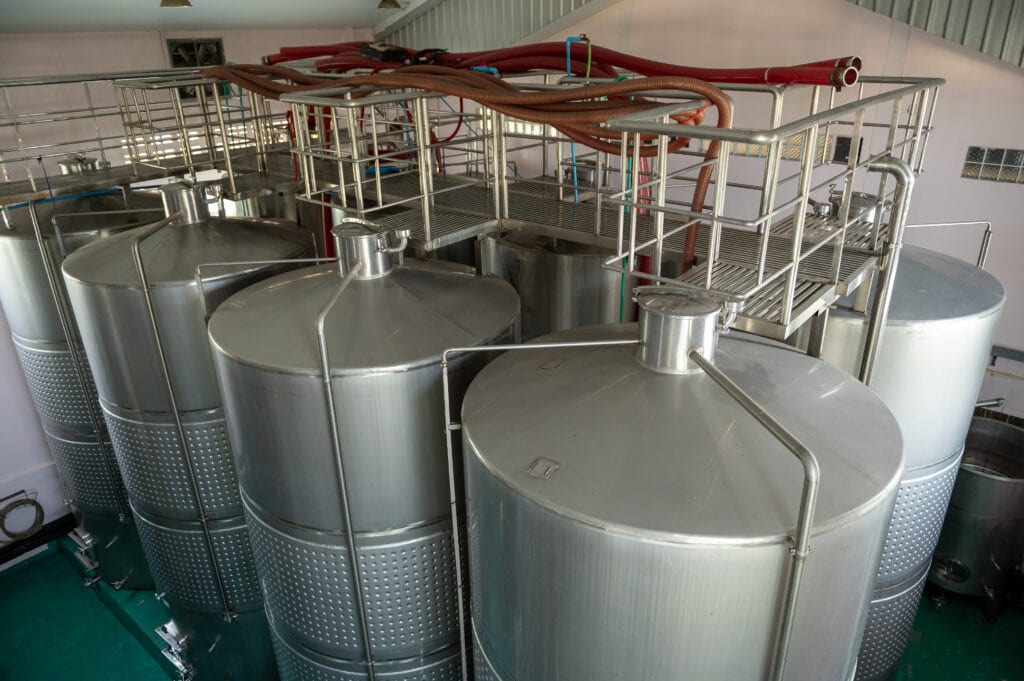
Surfaces must be smooth, crevice-free, and sanitary so bacteria can’t hide. Weld beads must be polished to FDA or 3-A compliant Ra finishes. Even the wrong fastener choice can create a contamination point that shuts down a production line.
Tanks handling ingredients like chocolate, oils, or syrups require proper agitation, temperature control, and cleanability designed in from the start. Stainless steel is common, but not all stainless is equal; chloride cleaners, acidic products, and thermal cycling can attack cheaper alloys.
One overlooked detail can turn into a quality incident, an FDA audit, or a full-scale recall. This makes fabrication a frontline defender of consumer health.
Nuclear & Defense
No industry has higher expectations for documentation and traceability than nuclear and defense.
Here, fabrication must meet exacting standards for material selection, nondestructive testing, and long-term structural reliability (sometimes for equipment that won’t be inspected again for years).
Every weld is qualified. Every heat number is traced. Every process logged. The stakes include public safety and national security, meaning failure is not an option.
Fabrication teams working in this field require specialized certifications, a deep understanding of compliance codes, and the ability to reverse-engineer components that haven’t been manufactured for decades. It’s fabrication as engineering stewardship.
Industrial Water & Wastewater
If there’s one industry where corrosion never sleeps, it’s water treatment. Tanks, frames, and piping are constantly exposed to moisture, chlorides, ozone, and abrasive sediments. Even the airflow in sump locations can accelerate rust on unprotected steel.
Equipment choices here rely heavily on coatings and corrosion prevention, epoxy linings for process vessels, stainless materials in high-chloride service, and robust fabrication for pump supports that vibrate 24/7.
Because shutdown windows are limited and expensive, equipment must perform reliably for years, not just pass inspection on day one.
Refining & Petrochemical
Few environments test metal like refineries do. High heat, volatile chemicals, pressure cycling, and constant mechanical stress mean every weld, joint, and structural component must be engineered for the worst conditions imaginable.
Fabricators must account for:
- Heat-affected zones around welds
- Material expansion and contraction
- Corrosion under insulation
- Shock loads from process interruptions
Quality lapses here don’t just risk downtime; they risk explosions, fires, and environmental fallout. Every component installed must be built to code, thoroughly tested, and ready for a lifetime of abuse.
Why Industry Experience Matters
A stainless tank that’s perfect for confectionery might fail in a wastewater plant. A carbon steel spool that thrives in power gen might corrode in months inside a chemical reactor building.
The biggest fabrication failures happen not because the wrong metal was used, but because the wrong expertise was used. When the fabricator understands the environment, the regulations, and the operational pressures of your industry, the project succeeds before the first plate is rolled.
What’s non-negotiable for power plant fabrication?
For power plants, what’s non-negotiable is code-compliant durability. This means qualified weld procedures, material traceability, and inspections that prove integrity over years of thermal cycling and pressure, not just a clean look on day one.
How do you keep tanks alive in harsh chemistries?
To keep tanks alive in harsh chemistries, you start with compatibility. Specify stainless or specialty alloys where needed, choose the correct coating/lining systems on carbon steel, and finish welds to eliminate crevices that chemicals exploit.
What makes a tank “sanitary”?
What truly makes a tank sanitary is smooth, crevice-free welds polished to compliant Ra finishes, cleanable geometry, and materials that tolerate aggressive CIP. A shiny exterior means nothing if the interior traps residue.
Why do water tanks fail early?
Water tanks fail early because relentless moisture, chlorides, ozone, and abrasion attack them. The fix involves proven coating systems on carbon steel, strategic use of stainless steel, and robust designs for 24/7 vibration resistance.
What must fabrication account for in the petrochemical and refining industries?
In refining, fabrication must account for heat-affected zones, expansion/contraction, corrosion under insulation, and shock loads. The margin for error is tiny, so design, welding, and inspection practices must anticipate the worst-case scenario.
Industry Standards and Certifications
In the world of industrial fabrication, precision and safety aren’t optional; they’re regulated.
Every weld, cut, and forming process must meet a standard that ensures the final product performs exactly as intended under pressure, stress, and temperature.
Schmidt Industrial Services operates under some of the strictest fabrication codes in the U.S., which gives clients something invaluable: peace of mind. When you see a U-Stamp or R-Stamp on a vessel or tank, you know it’s been built and tested to withstand whatever your process can throw at it.
ASME U-Stamp Certification
This certification isn’t a checkbox. It’s proof of rigorous oversight.
The ASME U-Stamp authorizes Schmidt to fabricate pressure vessels according to the standards of the American Society of Mechanical Engineers (ASME). Every welding process, filler material, and inspection must comply with ASME Section VIII, Division 1, to ensure the vessel can safely withstand internal pressure.
For clients, that means:
- All materials are traceable through MTRs (Material Test Reports).
- All welds are inspected using radiographic or ultrasonic testing.
- Every pressure boundary meets design thickness and stress requirements.
When you’re running a chemical plant or power generation facility, this isn’t just a detail; it’s what keeps people safe and production compliant.
NBIC R-Stamp Authorization
The NBIC R-Stamp is issued by the National Board of Boiler and Pressure Vessel Inspectors, which allows fabricators to perform repairs and alterations on existing equipment.
This is critical for facilities with aging infrastructure. Instead of replacing a vessel entirely, Schmidt can:
- Perform custom fabrication of replacement parts.
- Conduct welding repairs on-site or in-shop.
- Requalify the equipment with full documentation for continued service.
It’s one thing to build new; it’s another to rebuild something better.
What does it mean when a tank has an ASME U-Stamp?
When a tank bears an ASME U-Stamp, it indicates that it was constructed in accordance with the American Society of Mechanical Engineers (ASME) pressure vessel code. A U-Stamp certifies that the vessel was designed, fabricated, inspected, and pressure-tested under stringent standards for safety and reliability.
What’s the NBIC R-Stamp and why is it important?
The R-Stamp, issued by the National Board of Boiler and Pressure Vessel Inspectors, allows Schmidt to perform certified repairs and alterations on existing vessels. It ensures repaired equipment meets the same safety standards as new builds.
When do I need an NBIC R-Stamp?
You need an NBIC R-Stamp when performing certified repairs or alterations on code-stamped equipment. It’s how you bring an existing vessel back into compliant service.
Can we skip formal inspections if the fabricator is reputable?
Even with a reputable fabricator, you can’t skip inspections. Reputation helps, but radiography, UT, hydro/pneumatic tests, coating checks, and material traceability are what protect you during audits and over time.
How do standards affect maintenance planning?
Standards shape maintenance by defining not only how you build but how you repair. Having stamps and documentation now makes future work faster, cheaper, and audit-ready.
How to Choose the Right Metal Fabricator
Metal fabrication isn’t just another box to check during a project.
A fabrication decision made today can significantly impact (or compromise) equipment performance for decades. That’s why choosing the right fabrication partner is one of the most critical decisions a plant manager, engineer, or procurement team can make.
Most of the time, people focus on price and schedule first. And yes, those matter. But the real cost of fabrication isn’t what you pay upfront, it’s what you pay later if something goes wrong.
Let’s break down what “the right fit” actually looks like.
Certifications: No Room for Guesswork
If your application involves pressure, temperature swings, or regulated industries, certifications are non-negotiable. ASME and NBIC approvals aren’t just badges; they’re your assurance that the shop understands how to build safely and legally within strict codes.
If a fabricator ever responds to a certification question with, “Do we really need that?”, that’s your answer.
Walk away.
Industry Knowledge Changes Everything
A chocolate tank and a refinery vessel may both look like “big cylinders of steel,” but they couldn’t be more different.
If a fabricator doesn’t understand your industry, they won’t understand its risks. Food production requires sanitary welds polished to specific Ra finishes to prevent bacterial harbor points. Power generation depends on traceable materials and welds that can pass radiographic testing. Water plants count on coatings that won’t blister or shed into the supply.
When a fabricator truly understands your industry, they prevent problems long before the inspector ever arrives.
Capacity + Capability: Can They Actually Build What You Need?
Some shops are experts in small brackets and sheet metal. Others are equipped to handle 30,000-lb vessels. You don’t want to be someone’s “first time” with a tank twice the size they’ve ever built before.
You’re looking for:
- The right rolling equipment
- The right handling and lifting systems
- The right machining capabilities for thick sections
- The right welding processes for your metal and application
If you’re building a pressure vessel and a fabricator is still Googling “how thick is too thick?”, maybe keep searching.
Quality Control You Can Feel Confident In
A visually flawless weld can still fail inspection. True quality is proven through testing. Tests (such as ultrasonic testing, radiography, hydrostatic pressure testing, and coating thickness verification) are the kind of rigorous checks that ensure a fabricator isn’t just finishing a project, but also validating it.
Shops that cut corners on inspections rarely admit it upfront. Ask for proof. Any reputable fabricator will already have the necessary paperwork ready.
Documentation: The Secret to Passing Future Audits
Regulatory agencies don’t just examine your equipment; they also review the paperwork that accompanies it. Years down the road, when new staff are running the plant, documentation becomes your insurance policy.
Material traceability. Welding procedure qualifications. Coating certifications. Inspection reports. If it’s not documented, in a regulator’s eyes, it didn’t happen.
Project Schedule + Supply Chain Transparency
Metal fabrication doesn’t happen in a vacuum; it depends on mills, shipping schedules, coatings, inspections, and coordination. Anyone can promise a timeline. A qualified fabricator can explain:
- Where delays typically come from
- How materials are sourced
- What contingency plans exist if something shifts
If they can’t show you the plan, you become the plan.
Support After Delivery: Who’s Still There When Something Fails?
Even the best-built equipment needs maintenance and sometimes repairs. What happens when something breaks five years later? Does the fabricator retain drawings, certifications, and knowledge of your build? Can they reverse-engineer a damaged component? Can they help with compliance updates?
Your best partner is the one who picks up the phone long after the invoice is paid.
So, How Do You Know You’ve Found the Right Partner?
It’s simple, really: If a fabricator talks only about price and lead time, they’re a supplier. If they talk about service life, application environment, and compliance requirements, they’re a partner.
Great fabricators highlight risks you haven’t identified yet. They protect more than just the metal; they protect your uptime, regulatory status, and engineering reputation.
What’s the fastest way to screen a fabricator?
The fastest way to screen is to ask about certifications, industry experience, and in-house capabilities. If they can’t explain their code scope, show similar work, or handle your size/material needs, keep looking.
What can I expect from a robust QA/inspection program?
In a strong QA program, expect clear weld procedures and welder quals, defined NDE (UT, RT, PT/MT), pressure testing plans, coating inspection records, and complete material traceability. If it isn’t written, it didn’t happen.
Is the cheapest and fastest metal fabricator the right choice?
The cheapest and fastest option is only right if it still meets code, material, and inspection requirements — otherwise, rework, delays, and early failures erase the “savings.”
What does true partnership look like?
A true partner asks about process fluid, cleaning chemicals, pressure/temperature cycles, and audits. They flag risks early and suggest design tweaks that improve reliability and serviceability.
Why Experience Matters: The Schmidt Advantage
Every metal part, pressure vessel, and structural steel frame built by Schmidt carries decades of experience. While equipment and automation improve productivity, it is the human experience that ensures a reliable build.
Schmidt’s combination of history and technology gives clients something few can offer: true reliability from design to delivery.
Our promise:
- Fabrication that meets exact specifications
- Welds that pass every inspection
- Materials chosen for longevity, not convenience
- Real accountability, from the first cut to the final inspection
Ultimately, industrial metal fabrication isn’t about making parts; it’s about making performance possible.
Conclusion
Whether you’re planning a new build, upgrading aging infrastructure, or troubleshooting a compliance issue, Schmidt Industrial Services provides the expertise, equipment, and certification to deliver lasting results.
From custom fabrication and heavy-gauge roll forming to advanced welding and epoxy-coated tanks, every part of their process is designed to protect your investment and your reputation.
When precision matters, experience counts. And for over seven decades, Schmidt has proven that the difference between “good enough” and “built to last” is all in the fabrication.
Ready to Build Equipment That Lasts?
Whether you’re starting a new project or troubleshooting existing infrastructure, our team is here to help you make the right call before metal ever hits the shop floor. We’ll walk you through your requirements, assess your environment, and together find the most reliable path forward.
Get in touch with Schmidt Industrial Services today to start your next fabrication project with the confidence that it’s built for performance and built for the future.