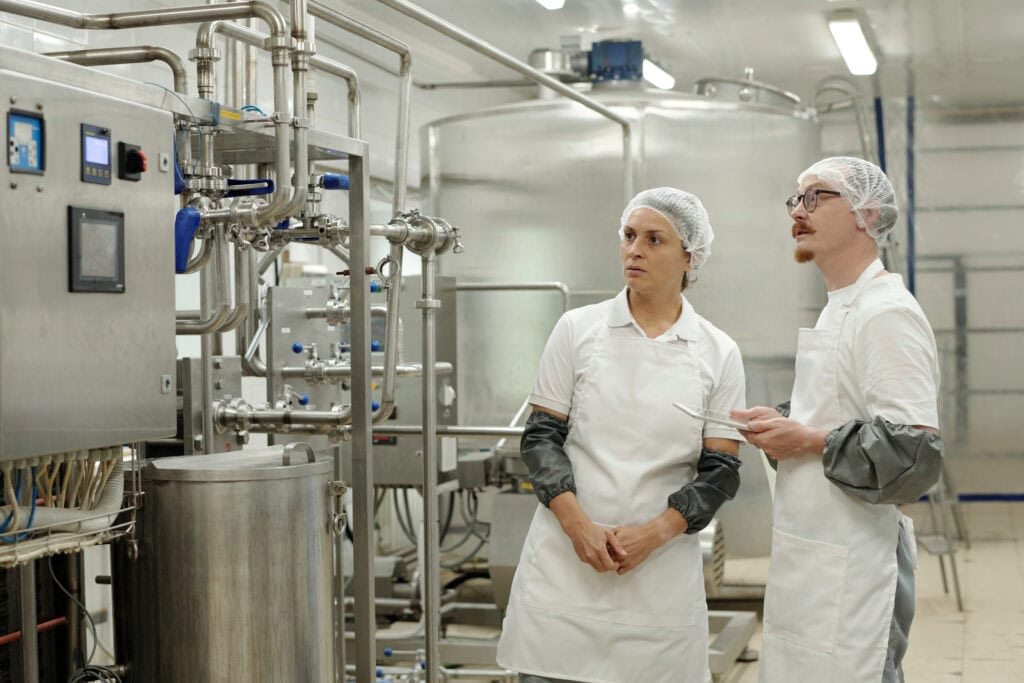
Unplanned downtime can cost food manufacturers up to $260,000 per hour in lost production, wasted materials, and missed orders.
For most facilities, the warning signs that it’s time to upgrade food manufacturing equipment appear long before the first catastrophic failure. Still, they’re subtle enough that teams get used to working around them until the situation becomes unavoidable.
The trouble is, once equipment failure escalates into a plant-wide interruption, the financial and operational impact is already severe.
Since 1948, Schmidt Industrial Services has helped food production facilities reduce downtime, protect compliance, and upgrade systems before they derail performance. We’ve seen the consequences of pushing equipment beyond its limits.
We’ve also seen the remarkable improvements when decisions are made proactively rather than reactively. This article is intended for plant managers, maintenance teams, and operations leaders who require clear, credible indicators that their equipment is impacting productivity, profitability, and plant efficiency.
No guesswork. No waiting for the next failure. Just the realities that matter…
Why Equipment Matters in Food Manufacturing
In food manufacturing, the performance of your equipment is the backbone of every successful operation. When machines run smoothly, plants achieve higher productivity, maintain product quality, and meet customer demand without disruption.
However, as equipment ages or becomes outdated, the risk of unplanned downtime increases, resulting in production halts and costing organizations thousands of dollars per minute of downtime.
Upgrading equipment isn’t just about keeping up with technology; it’s a proactive strategy that directly impacts your plant’s efficiency, reliability, and bottom line. By investing in routine maintenance and timely upgrades, companies can reduce the frequency and severity of unplanned downtime, optimize power plant efficiency, and control operational costs.
The best part? These improvements not only help maintain consistent output but also protect your company’s reputation and legacy.
1. Unplanned Downtime Is Becoming a Routine Event
When equipment performance declines, the first thing that suffers is reliability.
Downtime can be divided into two main categories: planned downtime and unplanned downtime, each with distinct impacts on operations.
There are important differences between planned and unplanned downtime. Unplanned downtime is unexpected and disruptive, whereas planned downtime is scheduled in advance to allow for maintenance or upgrades, thereby minimizing operational interruptions.
During unplanned downtime, line operators lose time restarting machines, sanitation schedules are disrupted, and maintenance teams often abandon preventive tasks to address emergency repairs. In contrast, planned downtime allows maintenance to be managed proactively, ensuring work is done at convenient times while preventing more significant issues and improving system performance.
The longer that downtime continues, the more revenue the company loses, and the more pressure is placed on staff to compensate for aging machines that can no longer keep up with operational demand.
When unplanned downtime becomes part of your routine, it’s time for a proactive fix; not another patch. Explore our repair and maintenance services to restore performance and protect production before the next costly breakdown.

2. Repair Costs Are Rising Faster Than Equipment Value
One of the clearest financial indicators of decline is the maintenance budget. As equipment ages, it typically requires more frequent fixes, more expensive parts, and longer periods of troubleshooting before it comes back online.
Each service event seems manageable in the moment, but the annual total tells a different story. The amount of money lost due to frequent repairs and unplanned downtime can be substantial, quickly adding up to a significant financial burden for the organization.
A common benchmark in asset management is that once maintenance and repair spending reaches approximately 30–50% of the replacement cost within a single year, the equipment has entered a phase where upgrading is economically smarter than repairing.
Continuing to invest in machines with declining reliability ultimately increases costs, consumes skilled labor hours, and leaves the facility vulnerable to major breakdowns that carry significantly higher financial consequences.
Unsure whether to repair or replace? Our engineering and facility asset management experts can evaluate your systems and help you identify which upgrades deliver the best ROI for your plant.
3. Efficiency and Output Are Quietly Declining
There is a subtle but dangerous point in equipment aging where performance degrades so slowly that no single day feels alarming.
Batches begin taking a little longer. Utility usage creeps up. More scrap is generated, but production still finishes. These operational losses are often masked by excellent employees who adapt their workflows to compensate.
Yet over time, inefficiency translates directly into diminished productivity, lower profit margins, and fewer units produced per kilowatt of energy consumed or per labor hour worked. Facilities can calculate the impact of inefficiency by comparing current output and costs to historical benchmarks, quantifying losses in production and increased expenses.
Inefficiency hides in the gap between what the equipment used to deliver and what it offers today. When machinery can no longer support increasing output goals or accommodate new product formulations, the food manufacturing equipment effectively limits plant growth and competitiveness.
4. Food Safety and Compliance Are Getting Harder to Maintain
Aging systems not only jeopardize operations but also compromise compliance.
Surfaces that were once easily sanitized may now trap residues. Welds wear, coatings blister, and microscopic cracks provide harborage points for bacteria. Cleaning shifts extend beyond their scheduled windows, QA rejections increase, and auditors ask more challenging questions.
Meanwhile, regulatory expectations continue to evolve…
Manufacturers must meet stricter enforcement from agencies responsible for protecting consumers. When compliance becomes reactive instead of controlled, equipment upgrades become a requirement.
Compromised welds and worn coatings don’t just threaten compliance; they invite contamination. Our industrial coating and lining services restore sanitary surfaces, extend equipment life, and help you maintain FDA and USDA compliance standards with confidence.
5. Capacity Can’t Keep Up with Customer Demand
When customer orders grow but output does not, it is usually a sign that equipment has reached the limits of its mechanical capability.
Older machinery often struggles to meet modern expectations, such as increased SKU variety, stricter temperature precision, automated handling, or continuous processing. Plants often encounter bottlenecks, particularly during seasonal surges or periods of high volume.
Demand doesn’t slow down simply because a facility’s technology has. If expansion goals require greater throughput but current systems can’t handle it without longer shifts, additional staff, or constant adjustments, your equipment is hindering business growth. At that point, upgrading is not a maintenance decision; it is a revenue decision.

6. Audit Documentation Is Difficult to Track and Validate
Modern manufacturing doesn’t run only on steel, motors, and sensors; it runs on data.
Legacy systems that rely on manual record-keeping create vulnerabilities during inspections and retail audits. Relying on outdated computer systems can also increase the risk of system failures, making it difficult to access or manage audit documentation efficiently.
When documentation is stored across various spreadsheets, clipboards, and login-locked devices that only one person appears to have access to, it becomes more challenging to produce compliance proof quickly and accurately.
In short, a regulatory inquiry shouldn’t feel like a crisis.
If compliance monitoring and maintenance logs are missing information or require extensive detective work to compile, there is an unavoidable risk of errors, incomplete records, and potential citations. Upgrades that deliver better traceability improve both operational accountability and regulatory confidence.
7. Operators Spend More Time Troubleshooting Than Producing
One of the strongest indicators of failing equipment isn’t mechanical at all; it’s behavioral.
When operators know exactly how to “coax” a machine into working, when every shift uses different workarounds to prevent stoppages, or when training new employees requires teaching hidden steps instead of standard procedures, the equipment has already passed the point of reliability.
These situations often lead to recurring problems such as unexpected breakdowns, inconsistent performance, and increased troubleshooting time, all of which negatively impact productivity. Skilled workers should spend their time producing products, not compensating for failing hardware.
Beyond the operational effects, this scenario poses risks to human error that can compromise safety, quality, or regulatory compliance. When the only thing holding a system together is the expertise of your best people, the plant is one illness, one vacation, or one turnover event away from major downtime.

How Top Performers Stay Ahead of Equipment Failure
In the food manufacturing industry, the highest-performing plants don’t wait for equipment to fail. They understand that proactive upgrades are crucial to maintaining efficient, compliant, and profitable production over the long term. Instead of reacting to breakdowns, they blueprint modernization into their operational strategy… here’s how they do it.
They Strategically Schedule Improvements
One key differentiator is how these organizations schedule improvements. Instead of pulling equipment offline at peak times, they leverage routine maintenance periods, scheduled outages, and seasonal slowdowns to transition assets smoothly. Upgrades are integrated into standard operations rather than causing emergency interruptions.
They Understand Maintenance Correlates With Profitability.
Leading plants unapologetically prioritize maintenance management, employee training, regular risk audits, and redundancy systems. Everything they do is designed to minimize unplanned downtime and ensure that, if an issue does occur, production can continue without major disruptions.
Why?
They understand maintenance is tied to measurable improvements in output, reliability, or compliance performance.
They Don’t Fall for Short-Term Savings
Most importantly, these companies see modernization not as an expense but as a critical business function. They rely on lifecycle data and real-world performance metrics (not luck) to determine when equipment has reached the point where maintenance is more costly than replacement.
Plants that approach upgrades this way don’t just avoid breakdowns. They outperform competitors by eliminating avoidable costs and maximizing their facility’s ability to meet growing demand.
Final Thought: If Your Equipment Is Sending Signals…Listen
If any of these seven signs describe what’s happening in your facility, you are already in the upgrade window, and now is the ideal moment to act while you still control the outcome.
Ready to Future-Proof Your Food Manufacturing Equipment?
Is your facility starting to experience any of the warning signs we’ve outlined?
If so, then you’re already in the window where proactive upgrades can protect your profitability and your peace of mind. The truth is, waiting until failure occurs rarely saves money. It only shifts the cost from planned improvement to emergency recovery.
For more than 75 years, Schmidt Industrial Services has helped food manufacturers upgrade the equipment that keeps their lines running, from stainless steel storage tanks and mixing vessels to corrosion-resistant coatings, repairs, and reverse-engineered components that extend asset life.
We understand the operational, compliance, and sanitation demands your equipment must meet, and we build solutions that support those needs for the long haul. Whether you’re facing constant repairs, planning facility expansion, or simply want expert insight into where your risks are hiding, our team is here to help you make the right investment at the right time.
Whether you need immediate repairs and maintenance, long-term engineering support, or specialized fabrication and coatings, Schmidt’s team delivers turnkey solutions that protect uptime, compliance, and profitability. Contact Schmidt Industrial Services today to review your equipment and discover the most effective path forward.